One can not read the comment by Italo Calvino in "Maybe one morning going ... "Italo Calvino: very precise, effective:
http://quintalgia.blogspot.com/2009/05/eugenio-montale.html

Civilization technology for its part has not produced that war ("the crash rude, the castanets, the thrill / tambourines on pit thievish" V.16-17 The storm); brutal dictatorship ("the course is passed to a flight made hell / Alal between the brigands "v.8-9 Spring Hitler) who found support in mass, so that" no one is innocent "(V.19); horrible concentration camps and extermination of the condition of metaphors' man in mass society, regimented and monitored ("the chief guard of the eye through the peephole" Prisoner's Dream v.5), persecuted without cause ("the purge lasts forever without a" why "v.11).
Modern society has finally resulted in the standardization, consumerism, a culture industry of leisure and entertainment that has swept the great humanist tradition of Western society. M. nourishes deep suspicion mass culture and the commodification of art, producing alienation and lack of values. For M. will be the end of liberty as a result of the mass media with an increasing passivity of human beings, incapable of genuine human relationships ("everything suggests that modern man is more than ever a stranger living among strangers), while" a basic task of the culture industry is to entertain the man "or emotologicamente sviarlo by its very nature of being who asks questions (which was to function in Western art) to make a simple consumer product (" trouble if all decide to leave .. closed television ") with an inner emptiness that you are trying to fill by "Forever and ever more quickly what all."
The only way to react according to M. is to recover the values \u200b\u200bof the great cultural past in the hope that men "do not allow themselves to crush the mass collective" even though the flood has swept away the meaninglessness of modern humanist culture, like the Florence floods of '66 "has overwhelmed pack furniture, cards and pictures "jealously guarded by the poet. M. therefore sees itself threatened with the fate of man as much more produced, because today "art is the production of consumer goods, to be used and throw away waiting for a new world in which man has succeeded in freeing all also of his own conscience "(It 's still possible poetry 1975). Yet in one of the last poems (" Today it is fashionable ") says:
" We can only hope that some
anchorite distilling resin golden
rotting trunks of knowledge. "Eugenio Montale - You can still poetry
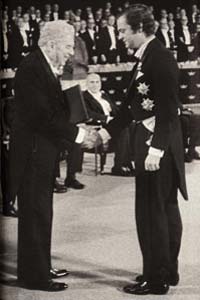
Montale speech for delivery of the Prize Nobel Prize for literature, Stockholm, December 12, 1975
II Nobel prize is now in its seventy-fifth round, if not misinformed. And if there are many scientists and writers who have earned this prestigious recognition, much less the number of survivors who still live and work. Some of them are present here and to them I extend my greetings and my best wishes. According to opinions very common, by omens are not always reliable, this year or years that can be said to be imminent the whole world (or at least that part of the civilized world who can say) knows a historic turning point of colossal proportions. This is obviously not an eschatological turning point, ending the man himself, but the advent of a new social harmony of which there are presented only in the vast domain of Utopia. At the end of the event will be the Nobel Prize Centennial and only then can he make a full stock of what the Nobel Foundation Prize and the related contributed to the formation of a new system of community life, be it that of universal well-being or sickness, but put an end to the extent that, at least for many centuries-old debate about the meaning of life. I refer to human life and not to the appearance of amino acids that dates back a few billion years, substances that have made possible the appearance of man and perhaps it already contained the project. And if so how long is the step of deus absconditus! But I will not wander and wonder if it is justified to conclude that the underlying statutes of the Nobel Prize, which is that science, not on the same floor, and literary works have helped to spread or defend new values \u200b\u200bin the broad sense "humanistic." The answer is certainly positive. It would be a long list of names of those who had given something to humanity have been awarded the coveted Nobel Prize. But infinitely long and impossible to identify the legion, the army of those who work for humanity in countless ways without realizing it and not ever aspire to any possible premium because they have no written works, and academic records and communications never have thought 'let the presses groan "says a popular cliché. There is certainly an exercice of pure souls, immaculate, and this is the obstacle (well enough) to spread the spirit of utilitarianism that goes in various ranges up to corruption, crime and all forms of violence and intolerance. Academics in Stockholm have said many times no intolerance, fanaticism, cruelty, and persecution that spirit that animates the often strong against the weak, the oppressed against the oppressors. This concerns particularly the choice of literary works that can sometimes be deadly, but never like the atomic bomb that is the ripest fruit of the eternal tree of evil.
not dwell on this button because they are neither a philosopher nor a sociologist, nor a moralist.
I wrote poems and was rewarded for this, but I was also a librarian, translator, literary critic and music, and even unemployed for insufficient recognition of loyalty to a regime that I could not love. A few days ago came to visit a foreign journalist asked me: "How many activities distributed so different? Many hours to poetry, many translations, many activities and many white-collar life? ". I tried to explain that you can not plan a life as you do with an industrial project. In the world there is a wide space for the useless, and indeed one of the dangers of our time is the commodification of uselessness which are particularly sensitive youngsters.
Anyway I'm here because I wrote poetry, an absolutely useless, but almost never harmful, and this is one of his titles of nobility. But is not the only, as the production or poetry absolutely endemic and incurable disease.
I'm here because I wrote poetry, six volumes, as well as numerous translations and critical essays. They said it is a production poor, perhaps assuming that the poet is a manufacturer of merchandise, machines must be used at most. Fortunately, the poem is not a commodity. It is an entity of which we know very little, so that two such different philosophers like Croce, an idealist and historicist Gilson, a Catholic, I would agree not a history of poetry. For my part, if I consider the poem as an object that rule is born from the need to add a vowel sound (word) at the first pounding of tribal music. Only much later were able to write words and music in some way and differentiate. It seems written poetry, but the common kinship with the music you hear. Poetry tends to unfold in ways architecture, there are the feet, the verses, the so-called closed forms. Still in the early sagas and legends of the Niebelungen then in those romances, the real subject of poetry is the sound. But will soon arise with the Provencal poets a poem that is also addressed to the eye. Slowly, the poetry becomes visual because it paints pictures, but it is also musical combines two arts into one. Of course, the formal patterns were largely the visibility of poetry. After the invention of printing poetry becomes vertical, does not fill all the white space, has lots of 'head' and shooting. Certain gaps have value. Quite different is the prose that fills the entire space and does not give guidance on its pronunziabilità. And here's metrical patterns can be an ideal tool for the art of storytelling, that is, for the novel. It 's the case of the narrative device that is the eighth, a fossil form that is already in the early nineteenth century, despite the success of Byron's Don Juan (poem was interrupted midway). But towards the end of the closed forms of poetry no longer meet either the eye or ear. A similar observation can be made for English blank verse and the Italian hendecasyllable dissolved. And in the meantime he strode the disintegration of the backlash was immediate and naturalism in painting. So, with a long process, which would take too long to describe, concludes that one can not reproduce the real, real objects, resulting in unnecessary duplication, but are exposed in vitro, or even natural objects or figures in Caravaggio or Rembrandt would have presented a facsimile, a masterpiece. The great exhibition in Venice years ago, was the portrait of a mongoloid: it was a topic
très dègoûtant , but why not? Art can justify everything. Except that we approached he saw that it was not a portrait, but unhappy in the flesh. The experiment was then interrupted by military force, but in the strictly theory was fully justified. For years critics who occupy university chairs preached the absolute necessity of the death of art, waiting for no one knows what palingenesis or resurrection of which we can glimpse the signs.
What conclusions can be drawn from such facts? Clearly, the arts, all the visual arts, are democratized in the worst sense of the word. Art is the production of consumer goods, to be used and throw away waiting for a new world in which man was able to get rid of everything, even his own conscience. The example that I took could be extended to only noisy music that you listen and undifferentiated in the places where millions of young people gather to exorcise the horror of their solitude. But why Today more than ever, the civilized man has come to have a horror of himself?
course expect objections. Do not confuse the social ills that might have existed but were little known because the old media is not allowed to know and diagnose the disease. But that impression is a kind of general millenarianism is accompanied by a more widespread comfort, the fact that the well-being (where it exists, that is in limited spaces of the earth) has the bruises connotations of despair.
Under the background of the affluent society so dark even the arts tend to merge, to lose their identity. Mass communications, radio and especially television, have not tried unsuccessfully to crush any possibility of solitude and reflection. The time is faster, works a few years ago seem 'dated' and the need for the artist to be heard sooner or later becomes spasmodic need current, immediate. Hence the new art of our time is the show, a performance theater that does not necessarily contribute to the rudiments of any art work and that sort of psychic massage on the viewer or listener or reader that is. The deus ex machina of this new accumulation is the director. Its purpose is not only to coordinate the preparations stage, but to provide intentions to actions which do not have or have had others. There is a great sterility in all this, and immense confidence in life. In this landscape of hysterical exhibitionism what is the most discreet place of the arts, poetry? The so-called lyric poetry is the work product of solitude and accumulation. It still is today, but in rather restricted cases. However, we have numerous cases in which the self-styled poet gets in step with changing times. The poem then becomes audible and visual. Words dart in all directions like the explosion of a grenade, there is no real meaning, but an earthquake epicenters with many minutes. The deciphering is not necessary in many cases can help the help of a psychoanalyst. Are predominantly visual poetry is translatable and that is something new in the history of aesthetics. This does not mean that the new poets are schizoid. Some can write prose and classically traditional pseudoversi no sense. There is also a poem written to be shouted in a square in front of an enthusiastic crowd. This is especially true in countries with authoritarian regimes. And like the athletes are not always helpless vocalism poetic talent. I will cite one case, and I apologize if it is also a case that concerns me personally. But the fact, if true, shows that there are now living together in two poems, one of which is for immediate consumption and dies as soon as it is expressed, while the other can sleep their quiet sleep. One day you wake up, if you have the strength to do so.
True poetry is similar to certain pictures of unknown owner and knows that only a few started. However, the poem does not live only in books or in school anthologies. The poet always ignored, and often ignores his real destination. I make a small personal example. In the archives of Italian newspapers obituaries of men are still alive and active. They are called crocodiles. A few years ago I discovered the Corriere della Sera my crocodile Zulberti signed by Tauler, critic, translator and polyglot. He stated that the great poet Mayakovsky, having read one or more of my poems translated into Russian language would say: "Here is a poet that I like. I wish I could read Italian. " The incident is not unlikely. My first poems began to circulate in 1925 and Mayakovsky (who traveled in America and elsewhere) he committed suicide in 1930.
Mayakovsky was a poet at the pantograph, the megaphone. If he uttered those words than I can say that my poems were found, distorted and unpredictable way, the recipient.
not believe, however, I have an idea of \u200b\u200bsolipsistic poetry. The idea of \u200b\u200bwriting so for those happy few was never mine. In fact, art is always for everyone and anyone. But what is unexpected is his true begetter
, its recipient. The art, exhibition, mass art, art that wants to produce a kind of physical and psychic massage on a hypothetical observer has before him because the endless roads of the world population is increasing. But its limit is the absolute vacuum. You can frame and display a pair of slippers (I myself have seen so reduced my own), but you can not expose a landscape under glass, a lake or any great natural spectacle.
Lyric poetry has certainly broke its barriers. There is poetry even in prose, in all the great prose is not merely utilitarian or didactic: there are poets who write in prose or at least more or less apparent prose million poets write verses which have no relationship with poetry. But this means little or nothing. The world is growing, what will its future can not say no. But it is not credible that the mass culture because it is ephemeral and does not result in run-down, needed to rebound, a culture that is also embankment and reflection. We can all collaborate on the future. But human life is short and life of the world can be almost infinitely long.
I thought to give my short speech this way: can poetry survive in the world of mass communications? And 'what many are asking, but to reflect well the answer can be affirmative. If you mean the so-called belletristica is clear that world production will grow dramatically. But if we limit ourselves to that which rejects the term horror production, the one that stands as a miracle and it seems to embalm its time and a whole linguistic and cultural situation, then we can say that there is no death for poetry.
E 'was observed several times that the recoil of the poetic language of prose about what can be considered a decisive blow of a whip. Strangely, Dante's Divine Comedy did not produce a creative prose that height or had done in centuries. But if you study the French prose before and after school of Ronsard, the Pleiade, you will find that the French prose has lost that softness for which he was considered so inferior to the classical languages \u200b\u200band took a leap of maturity. The effect was curious. La Pleiade not produce homogeneous collections of poems such as those of Italian sweet new style (which is certainly one of his sources), but gives us from time to time true "antiques" that will be part of a possible imaginary museum of poetry. This is a taste that you would say that centuries after the Greek Revival and Parnasse tried in vain to match. This proves that great lyric can die and be reborn trailer, but it is always one of the peaks of the human soul. We want to re-read together a song of Joachim Du Bellay. This poet, born in 1522 and died at only thirty-five, was the nephew of a cardinal in which he lived in Rome a few years bringing deep disgust with the corruption of the papal court. Du Bellay wrote a lot, more or less happily imitating the poets of the tradition of Petrarch. But poetry (perhaps written in Rome), inspired by the Latin verses Navagero, which recommends its fame, is the result a painful nostalgia for the countryside of the Loire sweet abandoned by him. Sainte-Beuve to Walter Pater, which he dedicated to Joachim a memorable profile, the short Odelette vanneurs des de blé entered the repertory of world poetry. Let's read it again if this is possible, because it is a poem in which the eye has its share.
A vous too legere,
here for EFTA PASSAGERE
volez par le monde, et
the murmur of a sifflant ombrageuse doulcement esbranlez vegetables,
j'offre violettes ces,
these lilies and these flowers,
and these roses here,
Vermeillet these roses
fresche all hatched,
oeilletz and these too.
of Your doulce Halain
eventer Ceste plain
Events This livingroom,
this while j'ahanne
was my wheat, I valve
the heat of the day.
Not so little ode to questa was written in Rome as a boring interlude in the handling of office practices. It owes its current Patter survival. Centuries later a poem can find its interpreter.
But now I have to conclude an answer to the question that gave a title to this short speech. In the current consumer society that look out to see new countries and new languages, history, human civilization in the robot, which may be the fate of poetry? The answers may be many. Poetry is the art technically available to everyone: just a piece of paper and a pencil and you're done. Only later problems arise printing and diffusion. The burning of the Library of Alexandria destroyed three quarters of Greek literature. Today not even a fire could get rid of the torrential universal poetic production today. But this is precisely the production of manufactured goods that is subject to the laws of taste and fashion. The garden of the Muses can be devastated by large storms is more than likely, yes. But it seems equally certain that many newspapers and many books of poetry must resist in time.
separate issue is whether it refers to the spiritual revival of an old poem, its current rebuild, its unfolding to new interpretations. And finally remains always doubt what limits and boundaries you are talking about moving poetry. Much poetry today is expressed in prose. Many verses of today are bad prose and prose. The art of fiction, the novel, from Murasaki to Proust has produced great works of poetry. And the theater? Many literary histories do not address either, although extrapolating some genes that form a separate chapter. Also: how do you explain the fact that the ancient Chinese poetry translations and will withstand all the European poetry is chained to its original language? Perhaps the phenomenon is explained by the fact that we believe to read Po Chu-i and instead we read the wonderful Arthur Waley infringer? One could multiply the questions with the only result that not only poetry, but the whole world of artistic or self-proclaimed that he entered into a crisis that is closely linked to the human condition, to our being human beings, our certainty or illusion to believe privileged beings, the only ones who think they are masters of their fate and the trustees of a destiny that no other living creature has. Therefore unnecessary to ask what will be the fate of the arts. It 's like asking if the man of tomorrow, perhaps a distant future, be able to resolve the tragic contradictions in which he discusses the first day of creation (and if such a day, which can be an age cut off, can still talk).
 http://nobelprize.org
0 comments:
Post a Comment